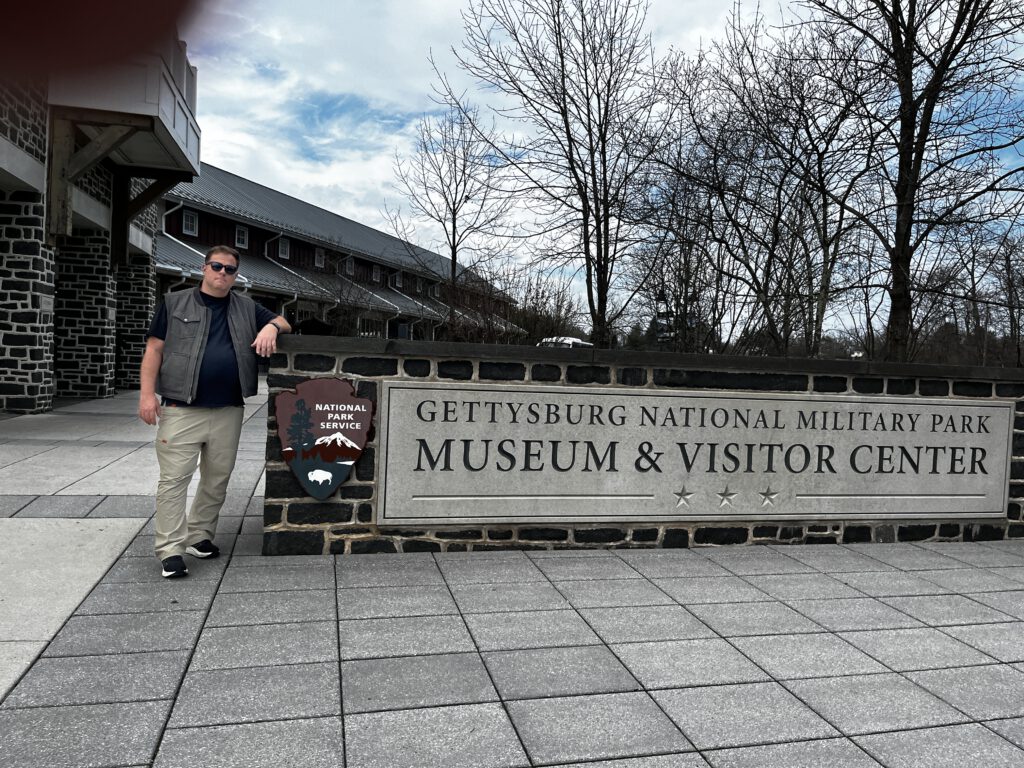
It’ll be 162 years ago come the first three days of July this year when the Battle of Gettysburg happened. I figured the best way to learn of the events over that three-day battle, the biggest battle of the U.S. Civil War, was to hire a tour guide.
Sure enough, the guides were an excellent investment. On Sunday we met a town tour guide, Ted Hirt, who for over 90 minutes directed us to the most important spots to show how, for example, the Confederates seem to have won the first day of the battle as they were chasing and pushing back Union troops from the center of town.
We asked a fair number of questions and he was delighted to answer, such as asking him why did General Robert E. Lee re-enter northern territory after suffering at the least a tactical defeat one year prior at the Battle of Antietam in Western Maryland.
Hirt explained, to paraphrase, that Lee was hoping at the very least to achieve a cease fire between the warring parties so that the North and South could commence negotiations for a truce.
But on the second day of the battle, it seemed momentum started to turn in favor of the Union Army as they were able to gain the high ground and prevent the Confederate Army from encircling the Union Army.
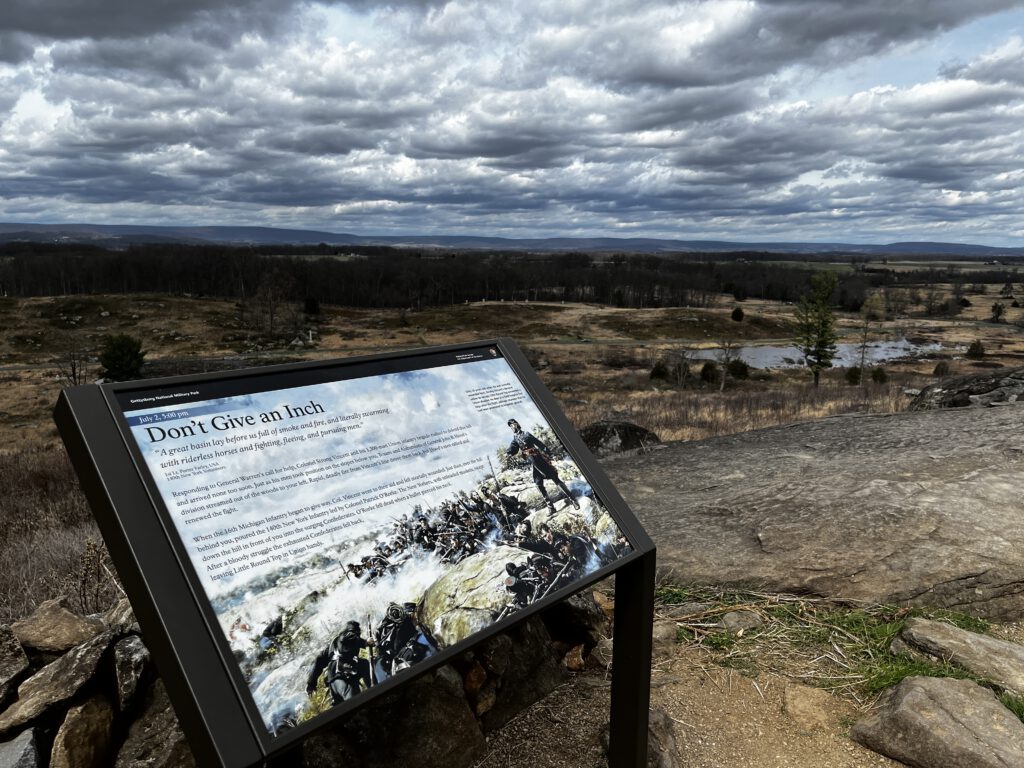
And that’s exactly what we would learn from our Monday tour guide, Bill Thomas of the Gettysburg Heritage Center, who explained that the high ground above the open fields, at a place called Little Round Top, is where the Northern army was to prevent the Confederates from advancing.
That particular piece of history is dramatized by the 1993 movie, “Gettysburg,” which featured a heavyweight of actors such as Martin Sheen playing Robert E. Lee, Sam Elliott depicting Union Brigadier General John Buford.
In the movie Jeff Daniels plays Colonel Joshua Lawrence Chamberlain from Maine, who led the defense of Little Round Top along the left side of the ridge.
But our tour guide Bill was quick to explain that the right side of the ridge was equally important and defended stubbornly by the Union Army led by Colonel Strong Vincent, Colonel Patrick O’Rourke and Lieutenant Charles E. Hazlett, who was in charge of artillery.
This is the second time within the past year of visiting a U.S. Civil War landmark. Last summer we traveled to Antietam, Maryland where a tour guide did a magnificent job in describing that one day’s battle, which was the single most loss of soldiers in American military history.
In contrast, Gettysburg was a three-day battle and over the course of those three days fatalities more than doubled compared to Antietam.
It’s been a wondrous tour of American history in the past year. There are many other U.S. Civil War-era battlefields that are operated by the National Park Service, such as Shiloh in Tennessee.
But there’s interest in the origins of the Blues, so looking forward possibly to a visit someday to the Mississippi Delta, between the Mississippi and Yazoo Rivers, maybe Clarksdale, MS.