
New York of the 1980s that is when my first full-time gig was in the tradeshow business at the Jacob K. Javits Convention Center. I entered at a young age the world of work, and if that wasn’t hard enough, me and all my fellow colleagues had to endure outright mob control.
But the mob’s business was all behind the scenes, but did show its face at times, like when I had to pay $10K in 1987 to ensure I was able to work full-time.
The hiring process daily was just like the movie On the Waterfront with Marlon Brando where the daily “shape” was conducted. Two union leaders with a list of names on the desk, and they would bark out the names, and the called-upon would walk up to get their work assignments and locations for the day.
I was one of several family members who shared the same surname and one time the union leader growled, “Bussanich, Bussanich and Bussanich!” Immediately, a lad standing during the shape said loudly, “Sounds like a law firm!” and the shape room bowled over.
It was a good ten year run until the excesses of mob control just proved too much for elected officials. In 1995, after George Pataki’s victory, one of his first acts as governor was to lead a purge at the Javits.
I was glad to see it happen, but the cost incurred was unemployment because from the governor’s perspective, we were all mobsters.
But the (mostly) guys I worked with were just hard-working and 30 years after that purge I still remember their sense of humor, endless jokes and laughing.
But a quite a few didn’t have a lot of positives to say, to put it lightly, when, for example, David Dinkins was elected Mayor of New York City in 1989. I’d recognized the parochialism: those of Irish heritage talked lousy of Italian heritages and vice versa. But when they worked together, oh boy, they were mad at everybody of color.
I guess that first experience working as a union member could have easily tainted my overall views of unions, but years later I worked for a NYC-based publication covering as a video reporter both organized labor and elected officials because in New York the two entities need each during the election cycle.
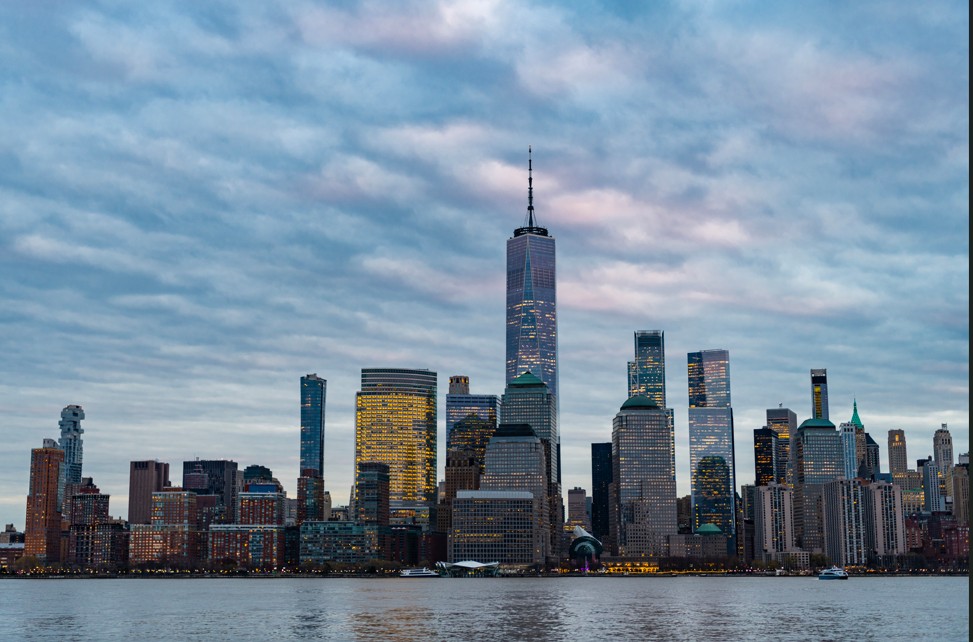
In 2013, twelve years after the September 11 terrorist attacks, I had the privilege to video record the construction of One World Trade Center, being ferried all the way up to the roof where I interviewed iron workers and crane operators who said they didn’t think they’d work on another project again that invoked rebuilding after a disaster and tragedy.
A memorable elected-official interview occurred when then-Governor Andrew Cuomo in 2014 was giving his budget speech to a large gathering at Cipriani’s across from Grand Central Terminal.
He was really focused in that speech to lower costs for New Yorkers, a noble effort for sure. But he wanted to cut a lot of taxes in housing, real estate and other sectors. I figured if the state was cutting taxes, how would it fund big ticket items like new infrastructure.
So after his speech, there was a media scrum and I was the only reporter with a tri-pod, camera and microphone. I asked him just that: how is the state going to fund big things.
I’m humble enough, but from thence that interview, he embarked on an infrastructure splurge: Moynihan Train Station, Mario Cuomo Bridge, Kosciuszko Bridge, JFK and LaGuardia Airports and, of course, Second Avenue Subway extension to East 96th Street.
President Biden continued the splurge on the national level, committing, for example, $66 billion to passenger railroading. With Donald Trump returning to The White House, will infrastructure spending continue or stall? Let’s see.